
The Golden Era of Supermodels: How the gaze changed
There was a time, between the 80s and 90s, when the entire world would stop in front of a photograph. Magazine covers became objects of desire, fashion shows were televised events, and models became modern-day goddesses. It was the golden era of supermodels, a period in which beauty went from being anonymous to becoming an icon, symbol, and global aspiration.
Naomi Campbell, Cindy Crawford, Claudia Schiffer, Linda Evangelista, Christy Turlington, Helena Christensen, and Kate Moss were not just perfect faces: they were presences. They had charisma, history, and a powerful identity that transcended fashion. Each one represented a different form of beauty, and together they created a visual language that changed culture forever.

INDEX:
1. The 80s: The Birth of the Myth

The 80s were synonymous with excess, glamour, and power. The economy was booming, consumption was expanding, and the body became the stage for success. In fashion, this energy was translated into exaggerated shapes, structured shoulders, intense makeup, and impossible hairstyles. It was in this context that the model's role began to transform. She was no longer just an interpreter of the design but its protagonist.
The most visionary designers, Gianni Versace, Thierry Mugler, and Jean Paul Gaultier, understood that the runway needed to be a spectacle, and the models were the stars. The catwalks were filled with music, drama, and attitude. Naomi Campbell walked with power; Linda Evangelista played with the camera like an actress; Cindy Crawford radiated strength and approachability. The public didn’t just want the clothes—they wanted the aura that came with them.
The advertising campaigns of that decade, shot by photographers like Herb Ritts, Richard Avedon, and Steven Meisel, built monumental images. The photos looked like living paintings. Shadows, lights, and bodies were all carefully designed to generate desire. It was beauty as a spectacle. Photography as an altar.
If you want to know more about the photography of the 80s, you can read our post: Fashion Photography in the 80s.
2. The 90s: The Humanity Behind Glamour
With the change of the decade, something began to shift. The world was starting to tire of excess. The gaze became more intimate, more emotional. Photographers sought a type of beauty that was less idealized, more relatable.
It was then that Peter Lindbergh revolutionized the aesthetic of the time with his famous Vogue cover (January 1990), where he gathered the five most iconic supermodels, without makeup and in black and white. The image was simple but profoundly powerful: it showed that real beauty could be just as striking as perfection.

The 90s were a decade of dualities. While Versace and Mugler continued to bet on excess and sensuality, a more natural and melancholic trend emerged, represented by photographers like Corinne Day and Juergen Teller, who captured the raw youth of a new generation: the grunge era and the Kate Moss phenomenon.
The ideal changed. It was no longer about looking like a goddess, but about looking human. The camera became confessional. Beauty, vulnerable.
3. Visual Culture: Before Pixels
This was also the last great era of analog imagery. Everything was done with light, film, and patience. There was no Photoshop, no filters, no automatic touch-ups. If a photograph turned out well, it was due to pure intuition, technique, and chemistry.
Photoshoots were rituals: the smell of makeup, the flash of the studio, the sound of the analog camera. Photographers sought the perfect moment; they didn’t fabricate it later. That’s why images from that time have something that seems lost today: soul. They were imperfect, but authentic. They had texture, movement, and breathed truth.
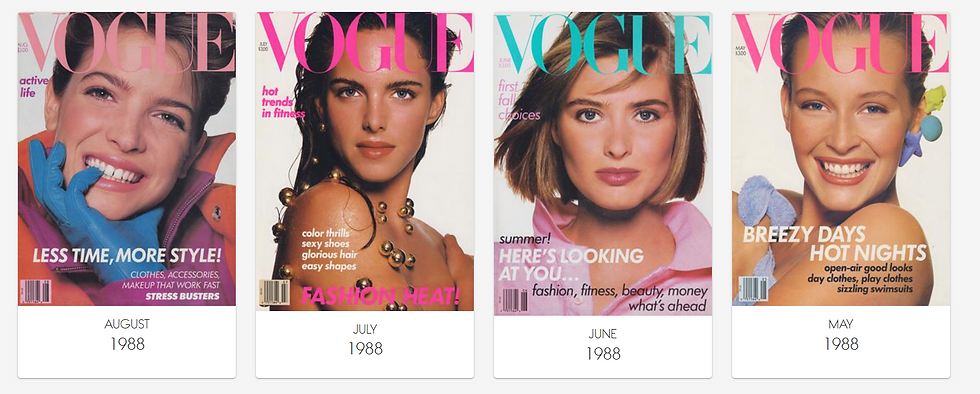
When we look at a cover from the '90s, we feel nostalgia not only for the fashion but for the way we viewed beauty. Before filters and editing, the camera still had the power to reveal, not to correct.
4. The Supermodel Myth

Supermodels were more than just perfect bodies: they were storytellers of an era. Each had a story to tell, an unmistakable style, a stage presence that turned clothing into emotion. They were ambassadors of a powerful yet complex femininity: strong, seductive, free.
They appeared in George Michael's music videos or in Calvin Klein campaigns, filling the screen with charisma and attitude. Their influence transcended fashion. They became icons of beauty, self-esteem, and empowerment. They were the first influencers, before social media.
Linda Evangelista summed it up with a quote that became legendary:
“I don’t get out of bed for less than $10,000 a day.”
It wasn’t arrogance; it was an awareness of their value. For the first time, models controlled their image and their narrative.
5. The End of an Era
At the end of the 90s, the world changed. The internet arrived, along with global campaigns, digital magazines, and soon after, digital retouching. Photoshop transformed the visual ideal: no longer did one have to wait for the perfect shot; it was enough to create it. Supermodels were replaced by celebrities, actresses, and later, influencers. The image became immediate, constant, infinite. The mystery disappeared. Perfection, on the other hand, became an obligation.
But despite everything, the echo of that era still lives on. The photographs of Herb Ritts or Lindbergh continue to circulate as works of art; the 90s campaigns by Versace or Chanel still inspire entire generations. Because what was created then wasn’t just fashion: it was visual history.

6. Legacy and Nostalgia
Today, in the midst of the age of artificial intelligence, we look back and understand something essential: those images didn’t just showcase beauty, but presence. They were portraits of real human beings, not digital simulations.
The golden age of supermodels taught us that the camera doesn’t just capture faces, but attitudes. That a glance can tell more than a thousand filters. And that beauty, when authentic, transcends time.
Perhaps that’s why we keep returning to those photos. Because they remind us of a moment when fashion was art, models were muses, and the image was an experience lived with awe.
Naomi Campbell, Linda Evangelista, Carla Bruni, Niki Taylor, Nadja Auermann, and Claudia Schiffer photographed in 1993 by Steven Meisel.
The inspiration that remains alive at FotoProStudio
At FotoProStudio, that vision continues to be our inspiration. We believe in photography as art, not as artifice; in the power of light, expression, and authenticity. Just as the great photographers of the '80s and '90s captured the essence of an era, we strive to portray the essence of every person, brand, or story that comes through our studio.
We use today's technology—Photoshop, Artificial Intelligence, and professional retouching—but with the same respect for the image that defined that golden era: natural beauty, true emotion, and elegance without excess.
Because, in the end, a good photograph is not the one that disguises reality, but the one that reveals it with soul.


Comments