
From click to scroll: How digital behavior is changing the way we look at photos
We live surrounded by images. Every day, thousands of them pass before our eyes almost unnoticed. We swipe, scroll, “like,” and move on. Photography—that tool that once invited us to stop time—has become part of the endless flow of information crossing our screens.
In the past, looking at a photo was an act. Today, it is a gesture performed automatically. The digital era has transformed not only the way we produce and share images, but also how we look at them, process them, and feel them. In a context of visual overload, to look no longer means to observe—it means to scroll past.
This article proposes a pause: a reflection on how infinite scrolling has reconfigured our gaze, and how, through awareness, we can rediscover depth in a world of fleeting images.
TABLE OF CONTENTS:
1. We look more, but see less

Never before have so many images been produced and consumed as today. Social media, smartphones, and screens have turned us into constant spectators of an endless visual flow. In theory, this should expand our ability to observe the world. In practice, the opposite happens: we see more, but we look less.
Scrolling has taught us to look in a hurry. Each photograph competes for a few seconds of attention before disappearing under the swipe of a finger. There is no context, no story—just a fleeting sensation. Looking has become more of a reflex than an experience. What was once an act of connection between photographer, image, and viewer now dissolves in a sea of instant stimuli.
2. From contemplation to consumption: a shift in the gaze

There was a time when photos lived in albums, hung on walls, or were stored in shoeboxes. They were viewed slowly, shared in silence, interpreted with emotion. Each image had symbolic value: it was testimony, memory, identity.
Today, the dynamic has changed completely. Photography has shifted from an object of contemplation to a consumable product. We swipe, rate, forget. A photo lasts only as long as a scroll. Emotion becomes brief, attention fragments, and the gaze loses depth. We become accustomed to the immediate, the spectacular, to what shines for a moment before disappearing. In the process, our relationship with the visual has changed: we no longer look to understand, but to decide whether to move on or keep scrolling.
3. The brain in scroll mode: how we process digital images

Our brain is a pattern- and reward-seeking machine. When we scroll, each new image promises something: a surprise, a stimulus, a hit of dopamine. Digital platforms have learned to feed this circuit. The faster we consume images, the more we want to keep searching.
The result is a fragmented, almost reflexive mode of attention, where images become signals rather than stories. The brain adapts to the rhythm of the scroll: it captures the immediate—color, contrast, shape—but struggles to sustain its gaze long enough to process meaning or deep emotion. Seeing ceases to be a complex cognitive act and becomes an impulsive behavior. We look to feel something quickly, not necessarily something true.
4. The aesthetics of impact: how the digital environment shapes what we photograph
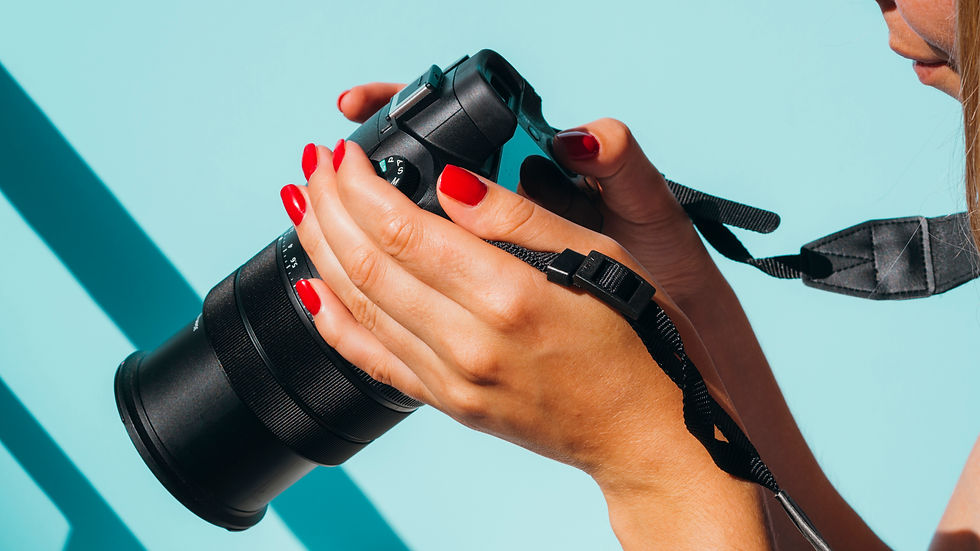
The shift affects not only the viewer but also the creator. If the audience looks in a hurry, the photographer learns to capture their attention. Images are designed to stand out on small screens, to shine in seconds, to stop the thumb mid-scroll. Thus arises the aesthetics of impact: saturated colors, high contrast, direct messages, explicit emotions. The algorithm rewards immediacy and punishes subtlety.
Brands, influencers, and photographers adapt their visual language to survive in an ecosystem of constant competition. The pursuit of likes often replaces the pursuit of meaning. What matters is not what the image says, but how long it can hold our attention. And, without realizing it, we also change what we photograph: we stop looking at what moves us and start looking at what “works.”
5. Toward a new way of looking

However, it is still possible to reclaim a more conscious gaze. It’s not about rejecting technology, but about reconnecting with attention. About remembering that behind every image there is a story, an intention, a point of view that deserves more than a second of scrolling.
Some practices can help us rediscover that lost depth:
Practice visual pause. Stop at an image that catches your attention. Breathe. Ask yourself what it shows, what it hides.
See less, but better. Reduce visual noise by carefully choosing what you follow and what you truly observe.
Photograph with intention. Not just to show, but to understand. Not just to please, but to say something. If you want to learn more about storytelling through photography, you can read Visual Narrative: When Your Image Not Only Shows, But Tells.
Return to paper. Print your photos, touch them, give them back their physical presence.
The challenge is not to stop looking, but to start truly seeing again. In the age of scrolling, attention is an act of resistance. And looking with awareness can be, now more than ever, a form of freedom.
If you want to take a moment to look calmly…
At FotoProStudio, we believe that every image deserves a pause. That’s why we create spaces, portraits, and projects that invite you to slow down, to reconnect with the emotion behind each photograph.
We invite you to visit our website and rediscover the beauty of looking with intention.


Comments