
An incredible journey to 1970s Fashion Photography

Ready to Time-Travel and Dive into the Glorious Era of 70s Fashion Photography?
Put on your silk scarf, adjust your oversized sunglasses, and get ready to discover crazy anecdotes, behind-the-scenes secrets, and fun facts that will light up any feed. Let’s blast off into the fabulous world of 1970s fashion photography, where bold styles, iconic photographers, and groundbreaking cultural shifts came together to create some of the most timeless images in fashion history. 🚀
1. Welcome to the boldest decade in fashion!
The 70s were an explosion of color, rebellion, and experimentation. From disco fever to bohemian glamour, fashion photography became a canvas for showcasing groundbreaking new styles. Can you imagine today’s supermodels with impossibly big afros and 20 cm platforms posing on runways surrounded by illuminated mirrors? That was the essence of the era: a psychedelic cocktail that still blows our minds today.
2. The rise of supermodels: From Twiggy to Pat Cleveland
Twiggy: The androgynous girl with doll-like eyes was the first supermodel. At 16, her fresh face and slim body revolutionized beauty standards. Her iconic eye makeup and geometric dresses continue to inspire many photographers today.

Model Twiggy on the cover of Vogue Pat Cleveland: was the first African-American model to shine on international magazine covers. Her charisma and infectious energy were captured by legendary photographers such as Sante D’Orazio, immortalizing her radiant laughter and triumphant spirit.
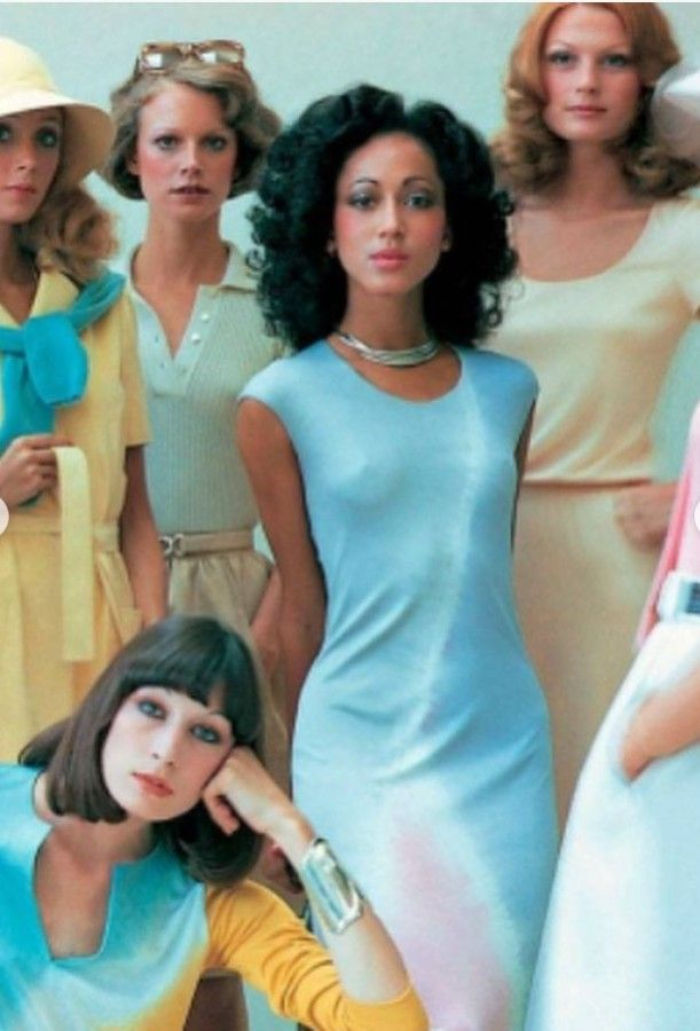
The model Pat Cleveland
Would you like to hear a fun fact? To capture Twiggy’s playful spirit, her photographer David Bailey placed little paper boats on the floor for her to jump over… and that’s how he achieved those dynamic poses!
3. Photographers who defined the ’70s
1) Helmut Newton
The German master of elegant eroticism. His black-and-white images blended luxury with provocation. Did you know Newton preferred shooting in luxurious hotels because he loved mirrors? He would set up a “mirror party” with models—and even himself—to play with impossible reflections!

2) Guy Bourdin
Saturated colors, surreal compositions, and a dramatic flair that bordered on the cinematic. Bourdin often retouched his negatives to the point of wearing them out—just imagine how obsessive he was about every curve and line!
3) Irving Penn
Pure minimalism. Penn favored neutral backgrounds and almost sculptural poses, giving full prominence to the shape and texture of the garments. His still lifes of shoes and fabrics began as experiments… but ended up becoming iconic!

4. Backstage antics
Life behind the scenes in the ’70s was a rollercoaster of disco music, cigarette smoke, and… flying saucers! Okay, the UFOs part is an exaggeration—but almost.
Polaroid quartet: Before shooting with their professional cameras, many photographers conducted a “test session” using Polaroids to check poses, lighting, and styling. Some of these are now auctioned for thousands of dollars!

Polaroid in the '70s Prop dogs: During the boho craze, some fashion directors brought prop animals (yes, fake ones!) for the models to interact with, making them appear more natural.
The dressing room anthem: Every photographer had their favorite song for a live moodboard. If you heard “Le Freak” by Chic or “I’m Every Woman” by Chaka Khan, you knew something epic was about to happen.
Did you know that Bianca Jagger, Andy Warhol’s muse, would protest if her favorite cocktail wasn’t served in the studio? A Martini with olives, of course. 😉

5. Analog technique: The art of imperfection
Today, we take Lightroom and instant previews on the camera’s screen for granted, but in the ’70s, photographers lived on the edge.
Roll after roll. Each photo was costly: developing, printing, and contact sheets. There was no room for error!
Skylights and windows. Many studios used natural light filtered through fabrics to create magical atmospheres. Remember those soft glows? They were pure artisanal ingenuity.
Developing in the bathtub. Some photographers developed film rolls in makeshift darkrooms—even in their own bathrooms! Hot water, chemicals, and a lot of courage.
Would you dare to shoot without seeing the results instantly? Surely, you have more than one “analog” experience worth sharing.
6. Style icons and their timeless looks
Farrah Fawcett: The red-haired goddess of “Charlie’s Angels” sparked a craze for wavy bangs and fitted shorts.

Farrah Fawcett David Bowie: With his alter ego Ziggy Stardust and androgynous makeup, he proved that fashion knows no gender.

David Bowie Bianca Jagger: With her wide-shouldered tailored suits, she established that power dressing is for both men… and women.
7. Fashion photography fun facts you didn’t know about the ’70s
The broken shoe flash. During a shoot, a model broke his shoe while jumping… and instead of stopping, the photographer used the flash burst to capture the perfect fracture!
Stolen props. It was said that some models “borrowed” hats and scarves from the studio as souvenirs. Today, they’re worth a fortune on vintage eBay.
Cigarette smoke as a filter. Yes, it was used to add mystery. Today it sounds toxic, but smoking sets were almost ritualistic sessions back then.
Improvised underwater photos. Without waterproof cameras, a genius placed a Nikon inside a sealed plastic bag for a poolside shoot. It worked… until the bag gave way! 😱
8. How it influences Instagram and TikTok today
The ’70s vibe has made a strong comeback on social media:
Nostalgic presets: filters that mimic film grain and warm tones.
Slow-motion on platforms: that open-vest pose with windblown hair… now tastes like vintage deluxe!
Pose challenges: #Poses70 where influencers recreate iconic moves from Jefferson Airplane.

9. Tips for recreating the ’70s look today
Color palette: burnt orange, earth brown, mustard, and turquoise.
Key pieces: flared pants, fringe jackets, blouses with psychedelic prints.
Statement accessories: oversized sunglasses, neck scarves, and maxi-deco necklaces.

’70s Fashion Photography Look DIY lighting: Use a white sheet as a diffuser and a floor lamp with a warm bulb.
Light post-production: add some grain, lower the contrast, and warm up the tones in your editor.
Don’t forget the attitude! A relaxed vibe and natural movement will make all the difference.
10. Conclusion: The enduring legacy
Fashion photography of the 1970s not only gave us spectacular images but also laid the foundation for the visual storytelling we use on social media today. Its blend of boldness, spontaneity, and handcrafted technique continues to inspire photographers, stylists, and influencers around the world.
And now, it’s your turn!
Tell us which anecdote, celebrity, model, photographer, or technique caught your attention the most.
Thank you for joining us on this journey to the past. See you at the next photo shoot! 📸🕺💃


trang chủ mb66 khiến mình muốn tìm hiểu kỹ hơn cách các khu vực được kết nối trong quá trình sử dụng. Mình thường bắt đầu bằng một phần quen thuộc rồi mở rộng sang những nội dung khác khi có thêm thời gian. Khi vào Xổ số, mình chú ý đến cách thông tin được cập nhật theo từng kỳ quay trước khi chuyển sang Thể thao để theo dõi các giải đấu. Trong một vài phiên, mình cũng mở phần hỗ trợ để xem những kênh liên hệ được giới thiệu trên trang. Sau khi quay lại nội dung chính, mình thường tiếp tục từ khu vực đang quan tâm. Những lần chuyển đổi này giúp mình hiểu rõ…
Tải Go88 made me look more closely at the way account functions sit alongside entertainment content on mobile. I had been browsing Mậu Binh before moving away to check an account-related section. The visual separation helped me recognize that I had entered a different part of the experience without losing the route back. After finishing there, I could return through the same familiar navigation structure. For me, this kind of distinction is useful because account tasks can appear at any point, and they feel less disruptive when their place in the interface is easy to understand.
https://qq88gg.net/ khiến mình chú ý đến những thay đổi trong cách tiếp nhận thông tin khi sử dụng lâu hơn. Trên máy tính, mình thường nhìn tổng thể trước khi lựa chọn, còn điện thoại khiến mình tập trung nhiều hơn vào từng khu vực. Khi tìm hiểu Nổ hũ, mình quan sát phần giới thiệu trò quay hũ và các cấp độ thưởng. Sau đó, mình chuyển sang Casino để xem nội dung tương tác với dealer rồi tiếp tục với Thể thao có tennis. Mình muốn đối chiếu cách các lựa chọn được trình bày trên từng thiết bị, đặc biệt là kích thước chữ và khoảng cách giữa những mục. Những khác biệt trong quá trình thao tác…
https://qq88pro.vip/ làm mình muốn tìm hiểu những phần trước đây ít khi dành thời gian quan sát. Có những chức năng chỉ trở nên đáng chú ý khi mình bắt đầu quan tâm đến toàn bộ quá trình sử dụng. Khi theo dõi Xổ số, mình thường xem cách các kỳ quay được phân chia và tìm hiểu những thông tin đi kèm. Sau đó, mình kiểm tra khu vực quản lý tài khoản để nhận biết vị trí các mục thông tin cá nhân. Điều mình chú ý là sự khác biệt giữa hoạt động giải trí và những chức năng phục vụ việc sử dụng lâu dài. Qua nhiều lần truy cập, mình dần quen với cách phân chia…
hi88 vẫn khiến mình chú ý đến cách một hành trình dài được duy trì khi có nhiều loại thao tác nối tiếp nhau. Mình thường bắt đầu với nội dung muốn trải nghiệm rồi mở rộng sang những phần khác tùy theo nhu cầu. Có lúc mình đi từ Thể thao sang Nổ hũ, tiếp tục với Đá gà rồi quay lại khu vực tài khoản để kiểm tra thông tin đăng nhập. Các danh mục có phạm vi riêng, trong khi những chức năng cá nhân cũng được tổ chức thành phần dễ nhận diện. Mình thường ghi nhớ hướng vừa đi qua để tiếp tục mà không phải tìm lại từ đầu. Sau nhiều lần sử dụng theo…