
AI-Generated Images: How Brands Like Zara, Stradivarius, and Coca-Cola Are Creating Campaigns
Artificial intelligence has transitioned from a distant promise to a tangible tool now in the hands of brands. In the realm of advertising imagery, its adoption is accelerating at an unprecedented rate. Automation, cost savings, and speed of execution... the advantages seem indisputable. But what happens when creative direction is replaced by algorithms? What occurs when brands entrust the visual representation of their products to a system that doesn't feel, doesn't observe, and doesn't understand culture?
In the following analysis, we examine real-world cases of brands that have embraced AI-generated imagery. This isn't about theory, but rather actual executions already visible on the streets. Images that have been seen, judged, loved, or criticized by millions of people. And they raise an uncomfortable question: Are we improving the system, or simply masking its emptiness?
Índice
1. Stradivarius and its AI-generated models
In May 2024, Stradivarius launched a social media campaign featuring models created entirely with artificial intelligence. The images were generated using commercial tools such as Midjourney and processed with Photoshop for minimal adjustments. According to internal sources, no traditional photoshoot took place, but artistic direction was involved to define the visual style, backgrounds, and the avatars' attitude.
There was no complex retouching afterward: the images were selected and fine-tuned from multiple outputs, with no direct human intervention in the anatomical generation or lighting. This introduces a new scenario: it is possible to create visual campaigns without photographic production, but not without aesthetic decisions. The result went viral on TikTok, but also received criticism for representing an artificial and exclusive beauty ideal.
imagen hecha con ia de una mujer con vaqueros y camisa rosa en un fondo de flores imagen generada con ia de una mujer con un top de flores y una blazer blanca imagen generada por ia de una mujer con vaqueros y camisa azul sobre un fondo de flores azules
AI-Generated Advertising Images by Stradivarius
2. Coca-Cola: Christmas without humans
In 2023, Coca-Cola launched a Christmas campaign featuring illustrations created by artificial intelligence, using systems such as DALL·E combined with post-editing in Adobe Illustrator and retouching in Photoshop. No human artists were involved in the illustration process: all visual material came from generative prompts guided by a content and marketing team.
There was no traditional art direction, but rather a prompt-based approach and iterative selection. While efficient, this process resulted in emotionally flat images. The reaction on social media was immediate: "Beautiful but soulless." Coca-Cola faced criticism for using AI during such an emotionally charged time of year, leaving out human illustrators and creatives who traditionally infuse warmth and empathy into their work.
Frames del anuncio de Navidad de Coca-Cola generado con Inteligencia Artificial Frames del anuncio de Navidad de Coca-Cola generado con Inteligencia Artificial
Frames from Coca-Cola's AI-Generated Christmas Ad
3. Burger King and the "Perfect" synthetic food
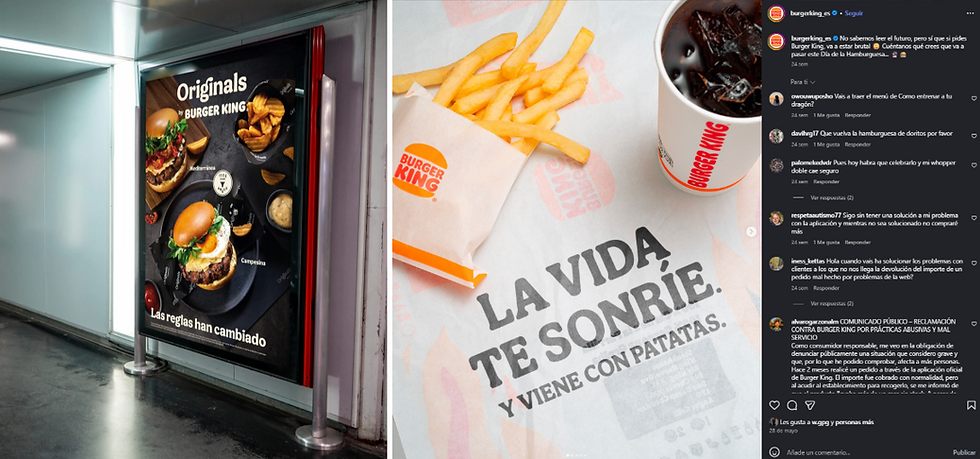
Burger King used AI to simulate catalog products through AI-generated 3D renders and CGI tools like Runway and Kaedim, which were then integrated into digital environments. The images were processed with minimal additional retouching; the aim was to represent the "ideal product" beyond the reality of the physical locations.
Art direction was minimal: efficiency and visual volume were prioritized over authenticity. This led to backlash on social media, where many consumers claimed to feel deceived. Visual fidelity was replaced with synthetic perfection, generating distrust. This case illustrates how a lack of human aesthetic oversight can result in a loss of connection with the customer.

4. Zara Home and the impossible interiors
Zara Home has not officially disclosed which of its images were generated with AI nor presented detailed case studies, but there is speculation that they are likely doing so.
It is believed that there was artistic direction: the internal team defined color schemes, composition, and the type of furniture to be represented. However, no traditional photoshoots or retouching were involved. The images were generated directly through AI + CGI, with minimal corrections.
This approach has sparked debate: many users questioned whether the spaces were real, and whether the products actually existed. Although visually flawless, the concept began to create friction with viewers. The risk of an unattainable aesthetic has become evident.
Fotografías de un salón generadas por Inteligencia Artificial Fotografías de un salón generadas por Inteligencia Artificial
AI-Generated Photographs of a Living Room
5. Heineken Silver: The beer that doesn't exist
In 2022, Heineken launched a fictitious campaign for "Heineken Silver," completely generated by AI as a satirical critique. Language models were used to create the storytelling, graphic design tools for the packaging, and visual generators like DALL·E to produce the images.
There was no artistic intervention or retouching: everything was executed as an experiment from start to finish. The campaign was conceived as a parody of blind enthusiasm for visual automation and served as a critical mirror to the industry. The brand demonstrated that it's possible to do everything without humans... but also highlighted the absurdity of abandoning real creativity.

Conclusion: An image can be perfect... and say nothing
These cases show that artificial intelligence is already here, shaping the aesthetics of major brands. And it does so with unsettling efficiency. But they also reveal something deeper: technology can replace processes, but not intentions. It can generate forms, but not meaning. It can create beauty, but not emotion.
An advertising image should not only be visually correct. It must be strategic, honest, and thoughtful. In a world saturated with simulations, authenticity becomes the ultimate luxury. And brands that forget this risk becoming their own caricature: perfectly irrelevant.
Because, in the end, it’s not about AI or no AI.
It’s about whether what you show... connects.



Comments